
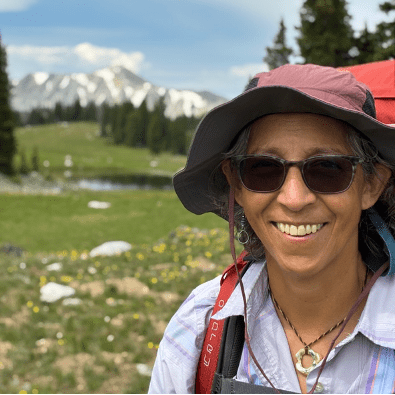
Jacquie Medina
Northern Michigan University
Jacquie Medina Ed.D. (she/her), is a Professor at Northern Michigan University, where she is the Coordinator of the Outdoor Recreation Leadership & Management undergraduate degree program. She is an NAI Certified Interpretive Trainer and ANFT Certified Nature and Forest Therapy Guide. Jacquie has been working in the outdoor industry for over 30 years with experiences teaching in higher education outdoor academic programs, leading extended wilderness trips, and facilitating interpretation and outdoor experiential education programs. Her passions include fostering human nature relations, experiential learning, and arts & culture.
As the Faculty Fellow for the NMU Office of Opportunity, Empowerment & People, Jacquie helps to implement research and programs that promote access to time in nature and outdoor recreation for all. Jacquie’s scholarship and service include collecting oral histories of outdoor recreation in the Upper Peninsula, exploring nature connection, and serving on steering committees for the Marquette Shoreline Cultural Trail and the BIPOC Outdoors Summit. Jacquie enjoys spending time with her family and pets, hiking, paddling, and exploring new places.

All Sessions by Jacquie Medina
1:15 pm
-
2:00 pm
Northern Lights
From Consultation to Co-Creation
Collaborative work is hard work, but it is necessary for a project to be authentic and meaningful. Using the City of Marquette Cultural Trail as the case study, participants will see why collaboration is worth the effort. Along seven miles of Lake Superior shoreline in Marquette, MI, the Cultural Trail is a storytelling project that uses public spaces, narrative, artwork, and history to connect us more deeply to the water, land, and one another. This session explores how to cultivate and nurture partnerships that become your network of support. We will discuss how to embrace the strengths of a multi-sector leadership table and move beyond 'consultation' towards 'co-creation'. Participants will learn to identify the stewards of a place and activate them by sharing ownership rather than working in silos. We will discuss how to observe what already exists so that projects build up, not parallel. This session will ask participants to self-reflect on who sits at your leadership table, which voices are missing from the conversation, and who might complicate your project in productive ways? No matter the project specifics, meaningful stewardship and effective conservation requires collaborative work. Join us to discuss how to leave room in your plan for the beautiful interruptions and foster community investment that lasts long after the ribbon-cutting.
1:15 pm
-
2:00 pm
Northern Lights
From Consultation to Co-Creation
Collaborative work is hard work, but it is necessary for a project to be authentic and meaningful. Using the City of Marquette Cultural Trail as the case study, participants will see why collaboration is worth the effort. Along seven miles of Lake Superior shoreline in Marquette, MI, the Cultural Trail is a storytelling project that uses public spaces, narrative, artwork, and history to connect us more deeply to the water, land, and one another. This session explores how to cultivate and nurture partnerships that become your network of support. We will discuss how to embrace the strengths of a multi-sector leadership table and move beyond 'consultation' towards 'co-creation'. Participants will learn to identify the stewards of a place and activate them by sharing ownership rather than working in silos. We will discuss how to observe what already exists so that projects build up, not parallel. This session will ask participants to self-reflect on who sits at your leadership table, which voices are missing from the conversation, and who might complicate your project in productive ways? No matter the project specifics, meaningful stewardship and effective conservation requires collaborative work. Join us to discuss how to leave room in your plan for the beautiful interruptions and foster community investment that lasts long after the ribbon-cutting.